City Utility Fees
How Will the City’s New Utility Fees Affect Residents?
On Sept 16, 2025, the Commission voted to increase the City’s water and wastewater fees about 8% each year for the next three years, and the community has already seen substantial increases in these and the stormwater and solid waste fees over the past five years.
The City Commission and City staff spend a lot of time examining the projects these rate increases are paying for, but they spend little time examining the financial impact of these increases on our residents and on the affordability of our community’s housing.
So the Coalition for Collaborative Governance researched each one of the City’s utility rate increases since 2020 to analyze how they are affecting Lawrence households. City staff doesn’t provide this historical comparative data, so we shared our research with the City Commission so they could better understand the impact of their decisions on an average Lawrence household and on households of different sizes and types.
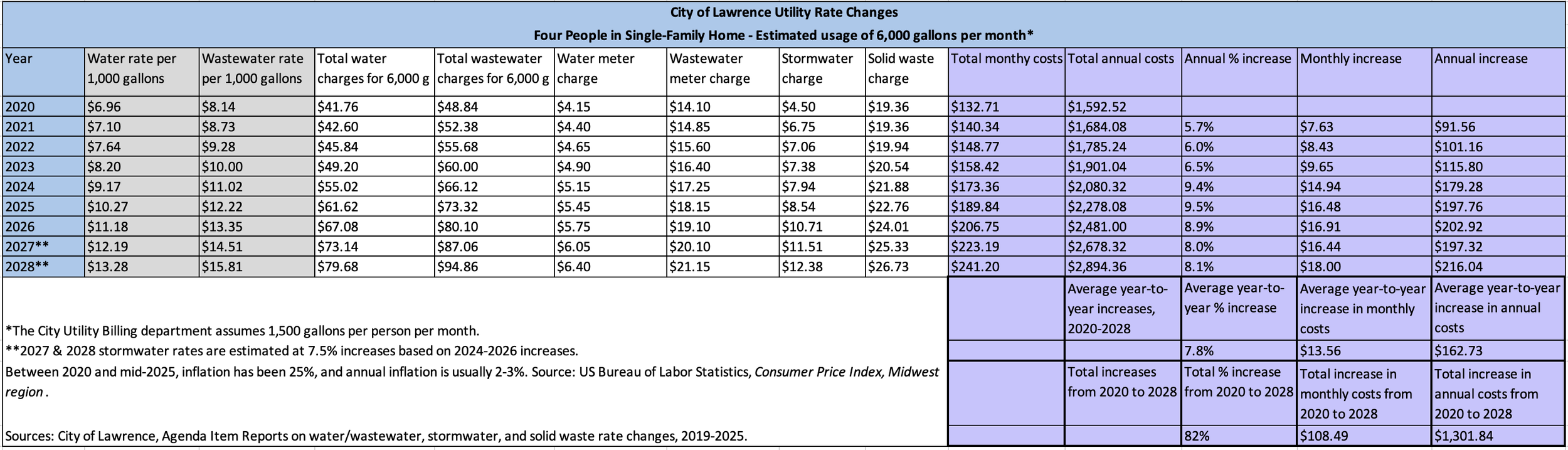
The cumulative effect of these increases is substantial. For example, an average family of four living in a single-family home in Lawrence can expect to pay a total of $1,300 more for their City utility bills in 2028 than they paid in 2020. This is an 82% increase over 8 years.
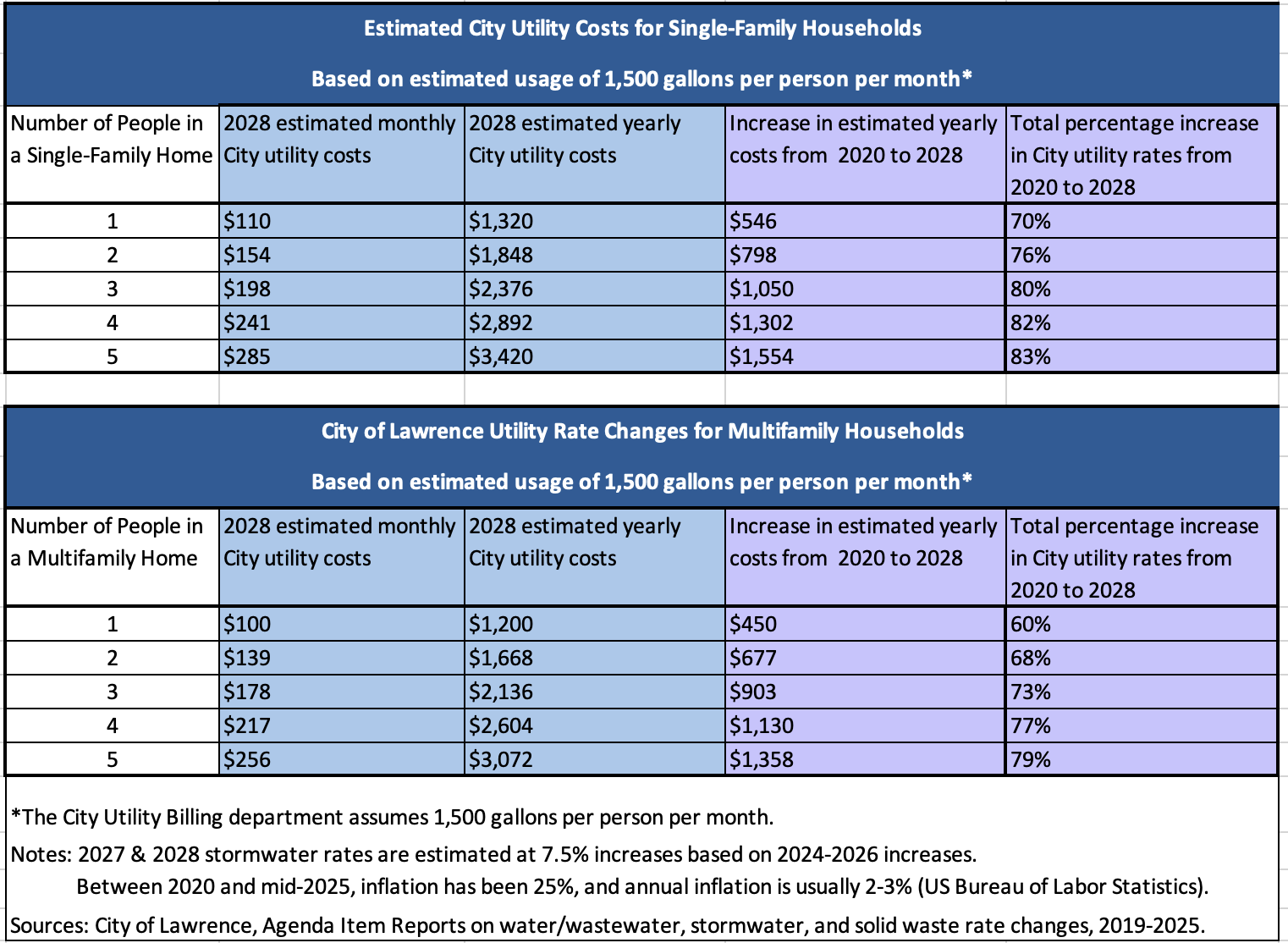
Our analysis revealed that a family of four in a single-family home should expect to pay about $240 per month for their City utility bill in 2028. Annually, this family would pay $1300 more in 2028 than they would have paid in 2020. A single resident in a single-family home would expect to pay $110 per month in 2028 and to pay $520 more annually in 2028 than in 2020.
For context, the median household income in Lawrence is $63,000.
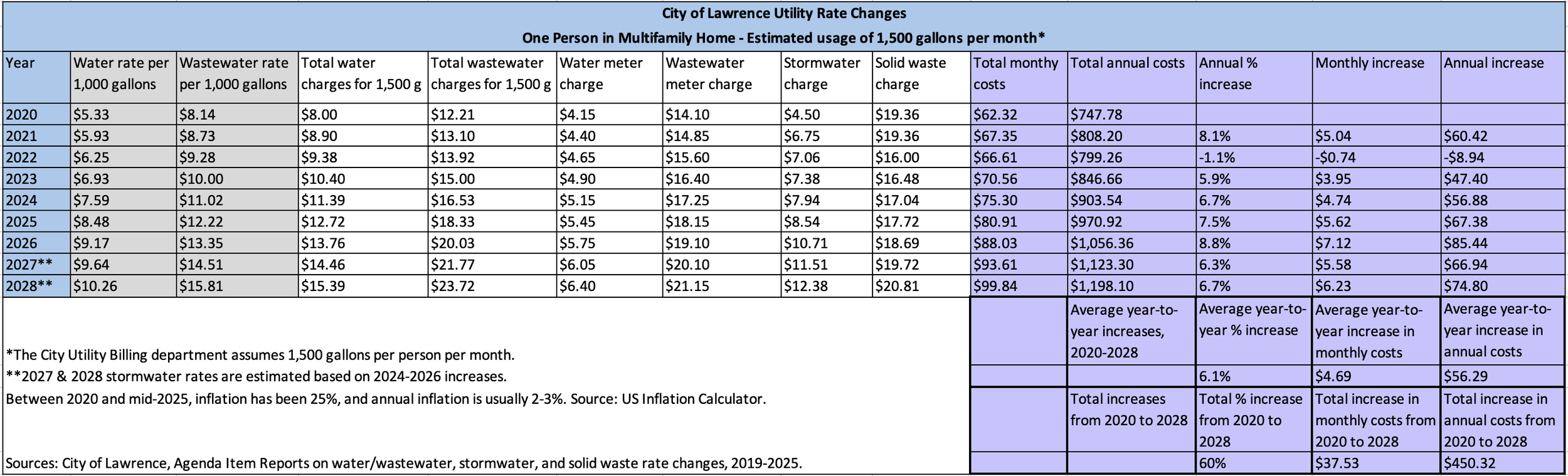
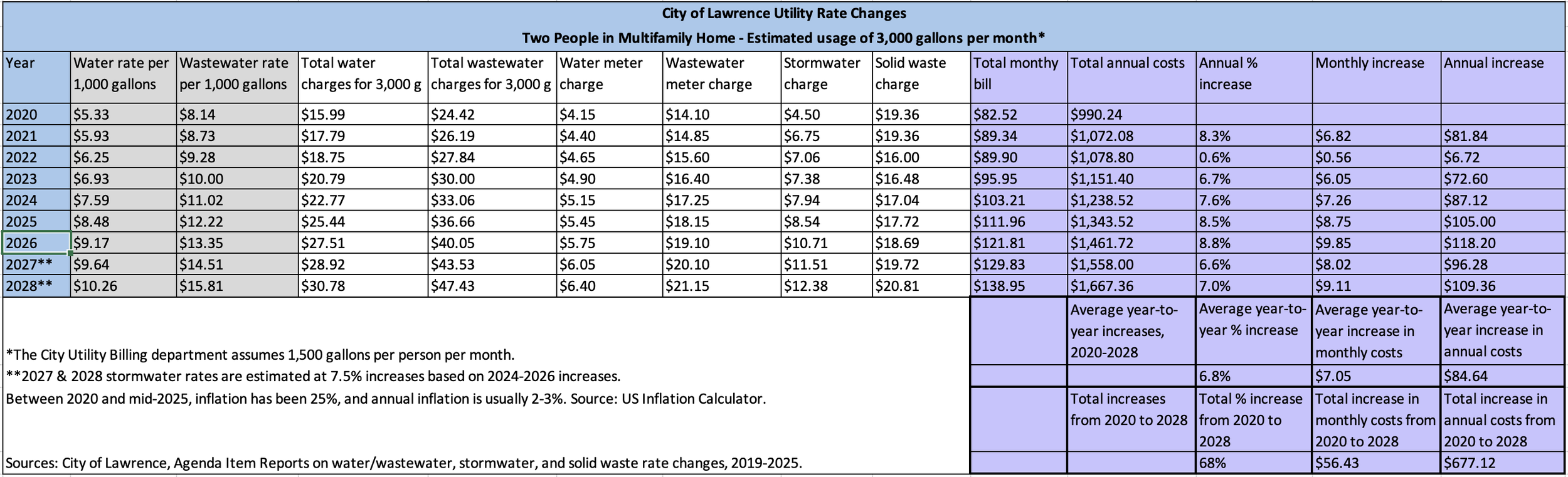
Residents living in multifamily homes, like apartments, should expect slightly lower increases, and he City does offer a 65% discount for low-income elderly residents who make less than $16.5K a year, or are the head of a household that makes $22.5K a year.
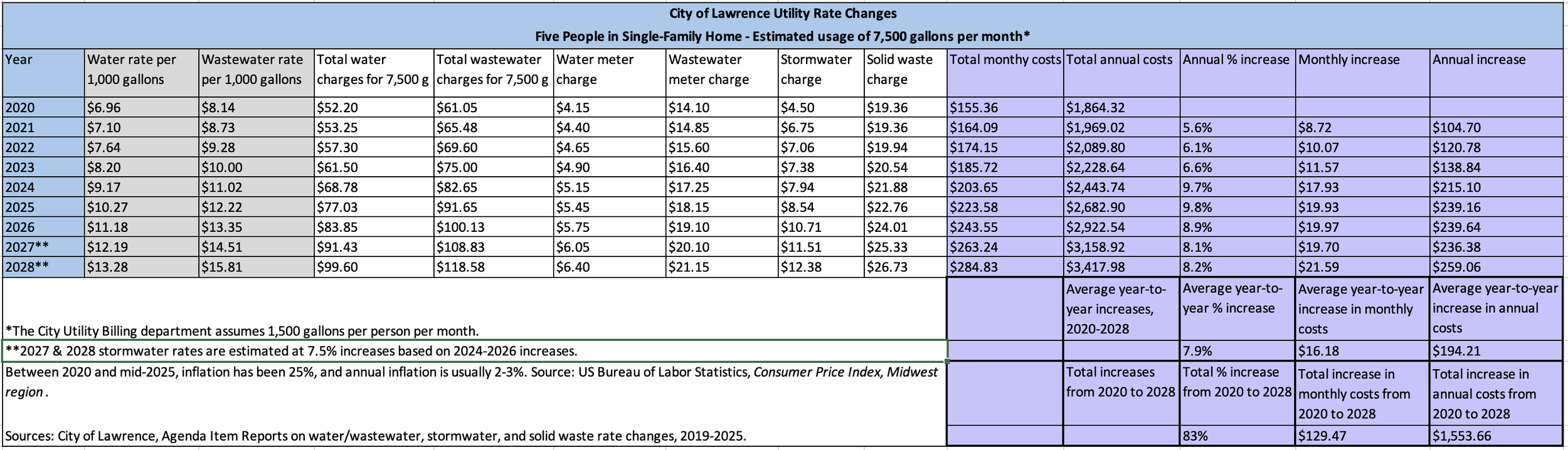
Increases in some of the utility fees have a greater impact on larger households. This means costs for a family of four in a single-family home would increase 82% in this eight-year period, while a single resident in a similar home faces a 70% increase in their fees. These rate increases are likely more than double inflation, which can be expected to be around 33% from 2020 to 2028.
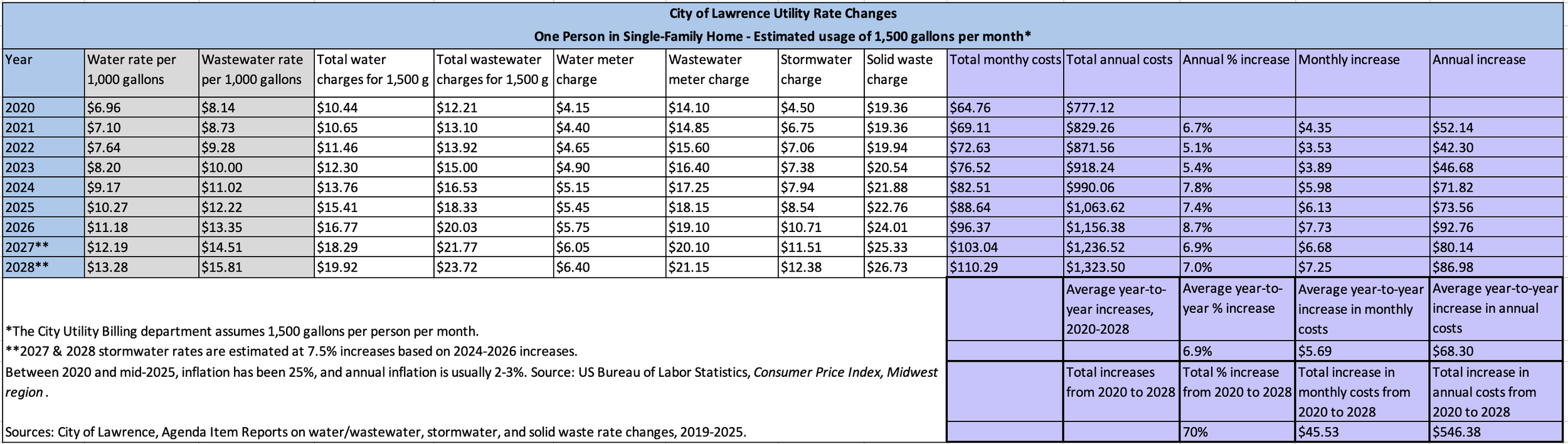
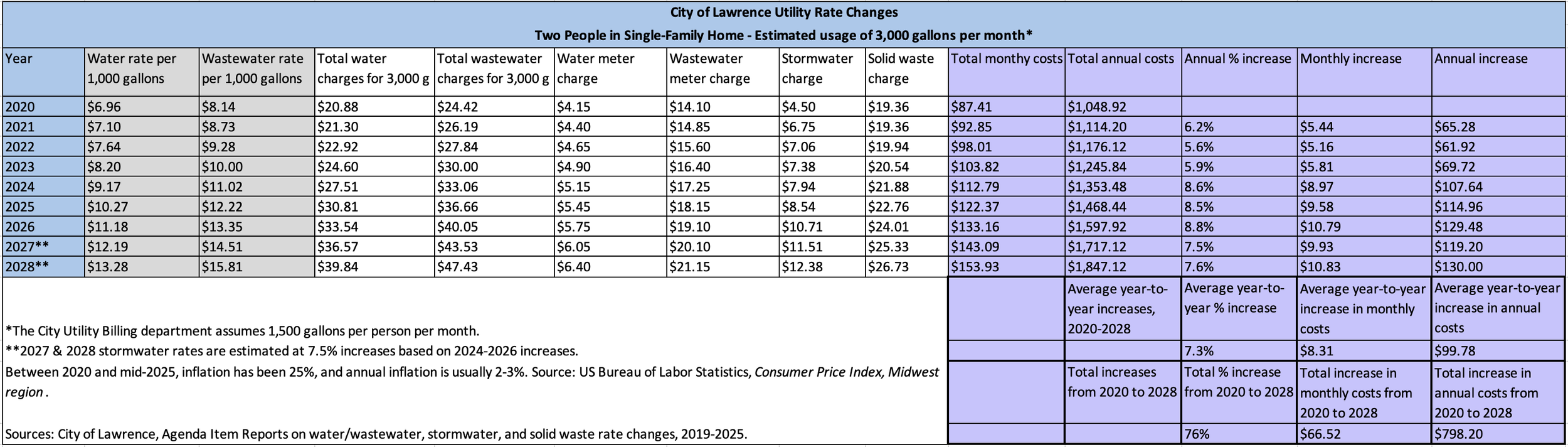
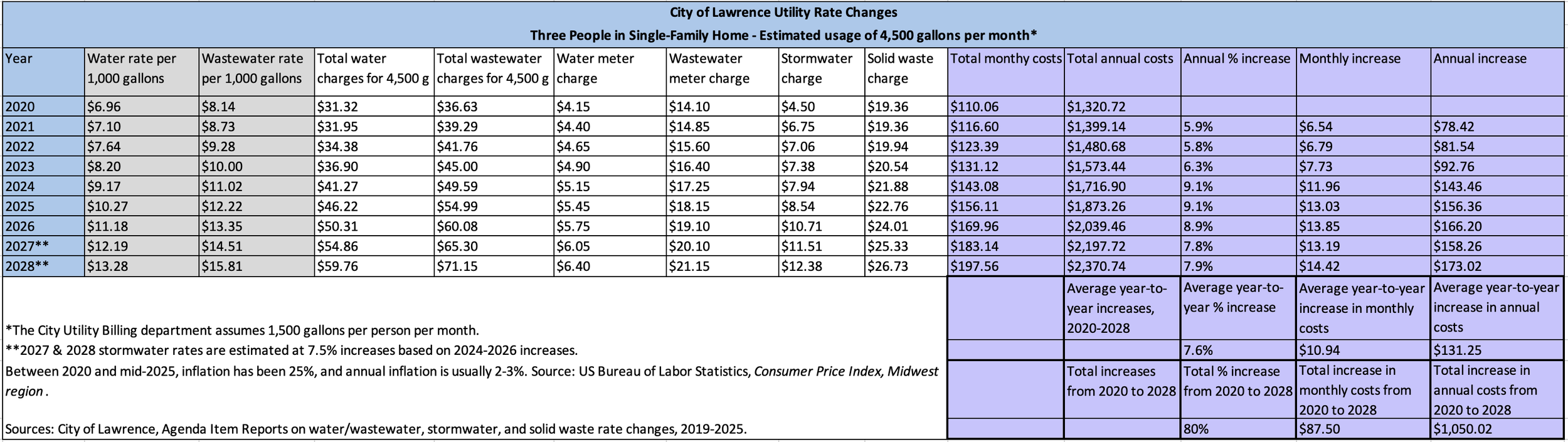
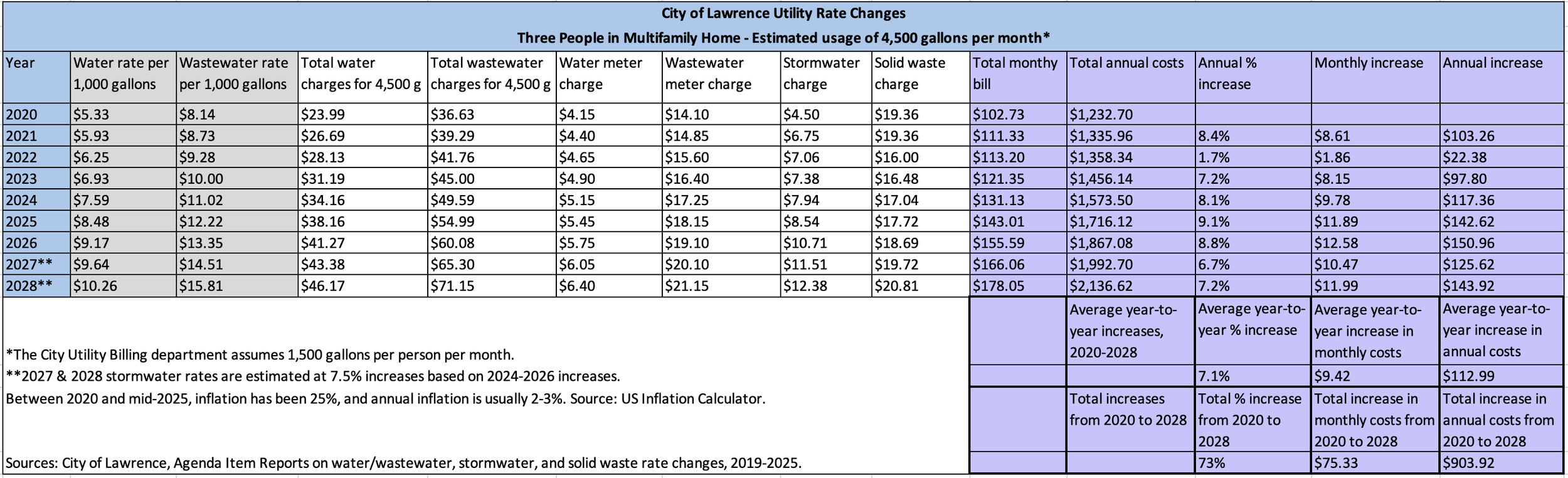
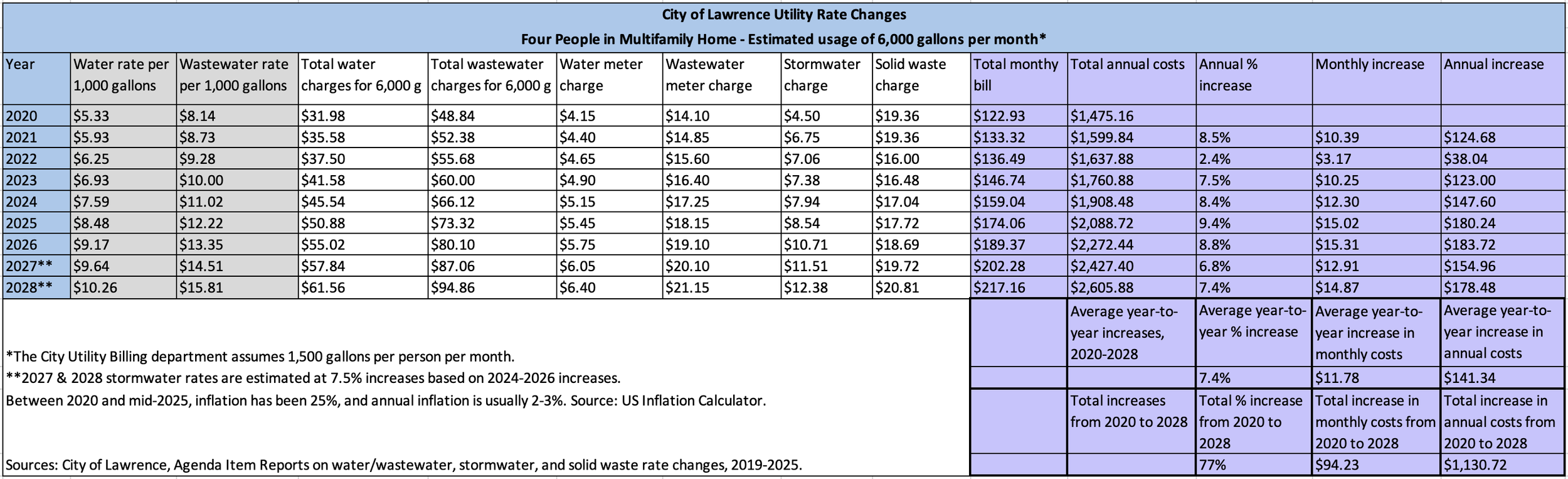
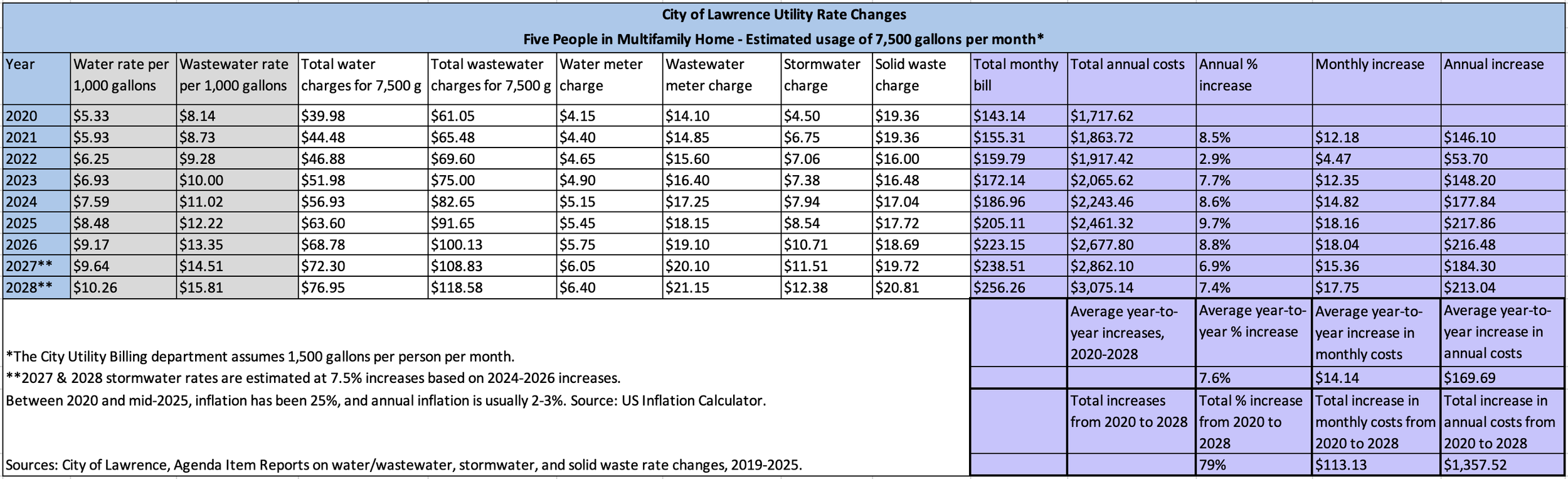
Below, you can see the detailed spreadsheets showing all the rates, charges, and calculations for each of these different populations. Finally, it’s worth noting that the City does offer a 65% discount for low-income elderly residents who make less than $16.5K a year, or are the head of a household that makes $22.5K a year.
You can also read our newspaper column about this topic here and The Lawrence Times article about our original analysis here.
City Utility Costs for Different Household Sizes and Types
References
Preliminary water service and sewage disposal service schedule, Agenda Item Report, 8/9/22.
Solid waste service, Agenda Item Report, 10/14/25.
Solid waste service, Agenda Item Report, 11/19/24.
Solid waste service, Agenda Item Report, 12/12/23.
Solid waste service, Agenda Item Report, 11/15/22.
Solid waste service, Agenda Item Report, 11/16/21.
Solid waste service, Agenda Item Report, 8/13/19.
Stormwater service, Agenda Item Report, 10/14/25.
Stormwater service, Agenda Item Report, 11/19/24.
Stormwater service, Agenda Item Report, 12/10/23.
Stormwater service, Agenda Item Report, 12/20/22.
Stormwater service, Agenda Item Report, 12/7/21.
Stormwater service, Agenda Item Report, 12/8/20.
U.S. Census Bureau, Quick Facts, Lawrence city, Kansas, 2023.
US Bureau of Labor Statistics, Consumer Price Index, Midwest region.
Water service and sewage disposal service schedule, Agenda Item Report, 9/12/25.
Water service and sewage disposal service schedule, Agenda Item report, 11/15/22.
Water service and sewage disposal service schedule, Agenda Item Report, 11/16/21.
Water service and sewage disposal service schedule, Agenda Item Report,12/8/20.