City Final 2027 Budget Decision
The City Commission votes on the City's final 2027 budget Tuesday, Sept 15.
The City's proposed budget requires increasing the City's property tax rate in order to pay for the new fire station's operations, continued 2.5-7.5% raises for staff, and substantially larger contributions to their employee healthcare program. The proposed budget includes a 1.1 mill increase for the City and 0.4 mills for the library for a total 4.5% increase in the City's property tax rate in one year.
City staff originally proposed a 3 mill increase in March, which got lowered to 2 mills in June when the City and County renegotiated their joint fire funding agreement. In just the last couple of weeks, staff found even more reductions to reduce the proposed mill increase to 1.1. We believe our and other residents' advocacy for the City to examine other budget solutions before raising the property tax rate contributed to this reduction in the proposed increase.
On the other hand, this increase continues a trajectory of increased City revenue, which has increased 52% in the last six years, significantly outpacing inflation. Substantial increases in property tax valuations and City utility fees have greatly outpaced average wage increases, so the cumulative impact of those increases and this proposed property tax increase is financially significant for residents.
Options for Budget Solutions
The Commission has discussed the budget at more meetings than usual this year, yet staff did not propose some of their most substantive budget reductions until eight hours before their public hearing two weeks ago. Our coalition had suggested some of these changes, as well as others, four months earlier. Some of our suggestions included:
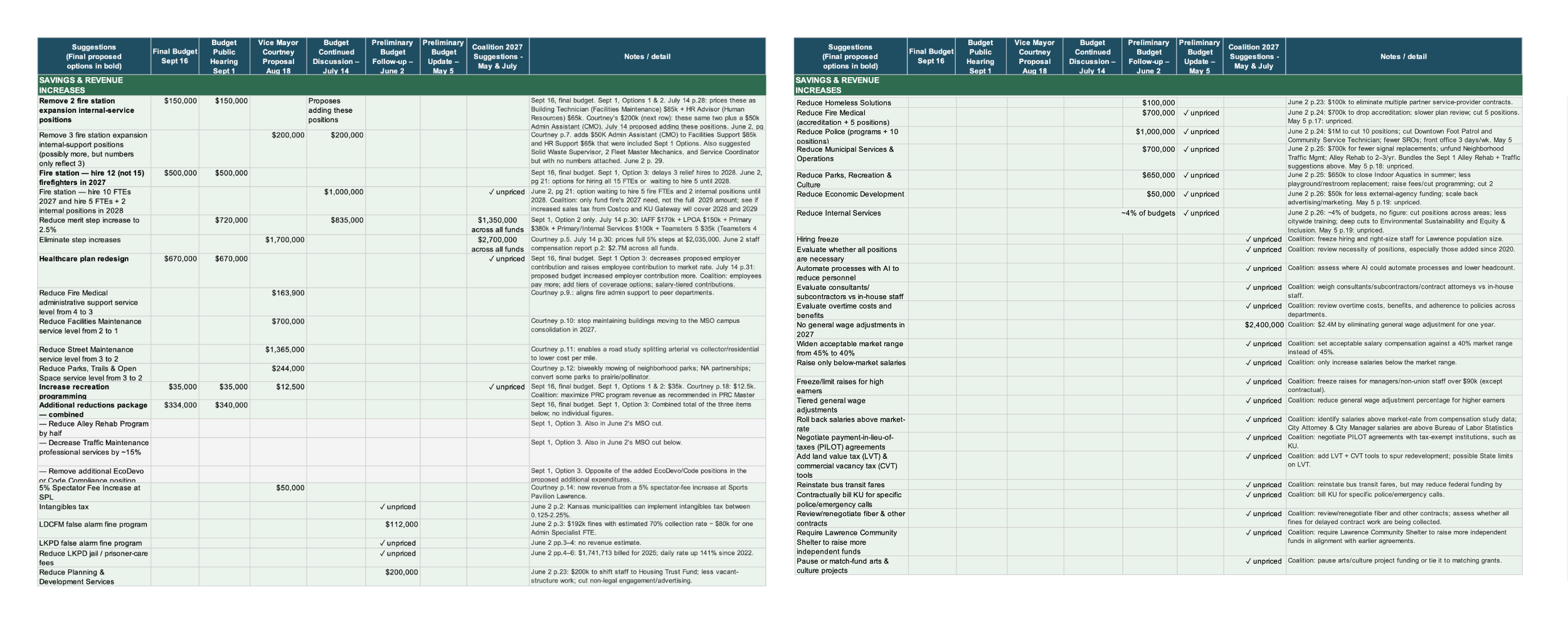
Phase in the full cost of the fire station, which isn't fully operational until 2029.
Require employees to pay more than their current 2.6% of insurance premiums.
Freeze hiring, evaluate the 77 positions added since 2020, and weigh in-house staff against consultants.
Reduce salary increases — skip the 2027 wage adjustment or step increases, raise only below-market salaries, or give smaller raises to high earners.
To see all the budget solutions proposed by our coalition, staff, and Vice Mayor Courtney, check out the spreadsheet below.
We had hoped that staff would have considered more of these options earlier in their process. Instead, in June, staff suggested cutting more services in the fire, police, and parks and rec departments, which have already been cut multiple years in a row. These suggestions included some highly unpalatable cuts, such as reducing downtown police foot patrol and School Resource Officers, rather than the much more palatable alternatives they are now considering. Other potential increased revenue sources that were mostly unexamined included false alarm fines, KU service contracts, and payment-in-lieu-of-taxes (PILOT) agreements with tax-exempt properties, such as KU.
Throughout the budget discussions, staff asked the Commission if they supported the current plan to provide all employees a 2.5% wage increase and most employees an additional 5% raise in the first 10 years of employment. At no point did staff present formal options to lower these raises, and at no point did the Commission publicly vote on these proposed raises. Staff negotiated union contracts with the proposed percentages, so the Commission is now committed to them in the final budget.
Staff members are valuable assets to the City's teams, and I recognize that discussing their salaries can be politically charged discussion. But I bring this issue up because reducing the size of these raises alone could have addressed the majority of the City's budget challenges.
The proposed budget does include a few welcome additions -- maintaining free access to the Community Building and expanding free parks and rec services for seniors, veterans, and 18-year-olds. We thank staff and the Commission for considering these additions.
The Reasons for the City's Budget Increases
Since March, the City has told the community it needs to raise taxes for the new fire station's operations.
The City's online budget community engagement only mentioned the new fire station as the chief reason for a multi-million dollar gap in the budget.
The City’s short four-question budget survey only asked about the fire station costs and recreation facility fees, but did not ask any questions about other major new expenses.
The staff reports have explicitly stated that the mill increase is proposed to support the fire station expansion, so this is how the newspapers have framed the City's budget deliberations.
While the community has been told we need to absorb higher taxes in order to support our fire department, the fire station operations actually account for only about 14% of this year's major increased costs. These include the following, most of which are consequences of deficiencies in previous years' budgets.
$7 million — employer contributions to the Health and Wellness Fund
$5.1 million — employee pay increases
$4.1 million — contribution to the General Fund fund balance
$2.6 million — Fire Station 6 operations
Property Taxes and Affordability
The 1.5 mill increase is a 4.5% increase in the City's property tax rate in one year. For a $300,000 home, that's only about $55 more per year. But it lands on top of an average 45% valuation increase since 2020. Since valuations rose an average of 5% this year, residents would pay roughly 9.5% more in City taxes in 2027 than this year. Some residents now report property taxes that exceed their mortgage payments.
Our nation faces an affordability crisis, and many households are strapped by housing, utilities, medical care, and groceries. The Commissioners can't address most of those costs, but they control the City's budget, taxes, and utility fees. One of the City's Strategic Plan goals is affordable housing, yet raising property taxes reduces affordability. We continue to ask the Commission to weigh how their budget decisions affect residents, many who may already be at their financial capacity.